
diff options
| author | Kubernetes Prow Robot <k8s-ci-robot@users.noreply.github.com> | 2019-01-08 10:06:08 -0800 |
|---|---|---|
| committer | GitHub <noreply@github.com> | 2019-01-08 10:06:08 -0800 |
| commit | cd961fad1e9d1c2c2ddf85e36a2f93c202c1da89 (patch) | |
| tree | 577a0fc5525cb525e8c1265149bb86872a65c8a7 | |
| parent | 2c5614f27ff05bf6d1f0e3f9cde8e05f954959df (diff) | |
| parent | 8be27917f5fbee1cd6e79eacca3d98d1509b78fe (diff) | |
Merge pull request #1680 from ConnorDoyle/numa-manager
Add Topology Manager proposal.
| -rw-r--r-- | contributors/design-proposals/node/topology-manager.md | 322 |
1 files changed, 322 insertions, 0 deletions
diff --git a/contributors/design-proposals/node/topology-manager.md b/contributors/design-proposals/node/topology-manager.md new file mode 100644 index 00000000..eb7032ef --- /dev/null +++ b/contributors/design-proposals/node/topology-manager.md @@ -0,0 +1,322 @@ +# Node Topology Manager + +_Authors:_ + +* @ConnorDoyle - Connor Doyle <connor.p.doyle@intel.com> +* @balajismaniam - Balaji Subramaniam <balaji.subramaniam@intel.com> +* @lmdaly - Louise M. Daly <louise.m.daly@intel.com> + +**Contents:** + +* [Overview](#overview) +* [Motivation](#motivation) + * [Goals](#goals) + * [Non-Goals](#non-goals) + * [User Stories](#user-stories) +* [Proposal](#proposal) + * [User Stories](#user-stories) + * [Proposed Changes](#proposed-changes) + * [New Component: Topology Manager](#new-component-topology-manager) + * [Computing Preferred Affinity](#computing-preferred-affinity) + * [New Interfaces](#new-interfaces) + * [Changes to Existing Components](#changes-to-existing-components) +* [Graduation Criteria](#graduation-criteria) + * [alpha (target v1.11)](#alpha-target-v1.11) + * [beta](#beta) + * [GA (stable)](#ga-stable) +* [Challenges](#challenges) +* [Limitations](#limitations) +* [Alternatives](#alternatives) +* [Reference](#reference) + +# Overview + +An increasing number of systems leverage a combination of CPUs and +hardware accelerators to support latency-critical execution and +high-throughput parallel computation. These include workloads in fields +such as telecommunications, scientific computing, machine learning, +financial services and data analytics. Such hybrid systems comprise a +high performance environment. + +In order to extract the best performance, optimizations related to CPU +isolation and memory and device locality are required. However, in +Kubernetes, these optimizations are handled by a disjoint set of +components. + +This proposal provides a mechanism to coordinate fine-grained hardware +resource assignments for different components in Kubernetes. + +# Motivation + +Multiple components in the Kubelet make decisions about system +topology-related assignments: + +- CPU manager + - The CPU manager makes decisions about the set of CPUs a container is +allowed to run on. The only implemented policy as of v1.8 is the static +one, which does not change assignments for the lifetime of a container. +- Device manager + - The device manager makes concrete device assignments to satisfy +container resource requirements. Generally devices are attached to one +peripheral interconnect. If the device manager and the CPU manager are +misaligned, all communication between the CPU and the device can incur +an additional hop over the processor interconnect fabric. +- Container Network Interface (CNI) + - NICs including SR-IOV Virtual Functions have affinity to one socket, +with measurable performance ramifications. + +*Related Issues:* + +- [Hardware topology awareness at node level (including NUMA)][k8s-issue-49964] +- [Discover nodes with NUMA architecture][nfd-issue-84] +- [Support VF interrupt binding to specified CPU][sriov-issue-10] +- [Proposal: CPU Affinity and NUMA Topology Awareness][proposal-affinity] + +Note that all of these concerns pertain only to multi-socket systems. Correct +behavior requires that the kernel receive accurate topology information from +the underlying hardware (typically via the SLIT table). See section 5.2.16 +and 5.2.17 of the +[ACPI Specification](http://www.acpi.info/DOWNLOADS/ACPIspec50.pdf) for more +information. + +## Goals + +- Arbitrate preferred socket affinity for containers based on input from + CPU manager and Device Manager. +- Provide an internal interface and pattern to integrate additional + topology-aware Kubelet components. + +## Non-Goals + +- _Inter-device connectivity:_ Decide device assignments based on direct + device interconnects. This issue can be separated from socket + locality. Inter-device topology can be considered entirely within the + scope of the Device Manager, after which it can emit possible + socket affinities. The policy to reach that decision can start simple + and iterate to include support for arbitrary inter-device graphs. +- _HugePages:_ This proposal assumes that pre-allocated HugePages are + spread among the available memory nodes in the system. We further assume + the operating system provides best-effort local page allocation for + containers (as long as sufficient HugePages are free on the local memory + node. +- _CNI:_ Changing the Container Networking Interface is out of scope for + this proposal. However, this design should be extensible enough to + accommodate network interface locality if the CNI adds support in the + future. This limitation is potentially mitigated by the possibility to + use the device plugin API as a stopgap solution for specialized + networking requirements. + +## User Stories + +*Story 1: Fast virtualized network functions* + +A user asks for a "fast network" and automatically gets all the various +pieces coordinated (hugepages, cpusets, network device) co-located on a +socket. + +*Story 2: Accelerated neural network training* + +A user asks for an accelerator device and some number of exclusive CPUs +in order to get the best training performance, due to socket-alignment of +the assigned CPUs and devices. + +# Proposal + +*Main idea: Two phase topology coherence protocol* + +Topology affinity is tracked at the container level, similar to devices and +CPU affinity. At pod admission time, a new component called the Topology +Manager collects possible configurations from the Device Manager and the +CPU Manager. The Topology Manager acts as an oracle for local alignment by +those same components when they make concrete resource allocations. We +expect the consulted components to use the inferred QoS class of each +pod in order to prioritize the importance of fulfilling optimal locality. + +## Proposed Changes + +### New Component: Topology Manager + +This proposal is focused on a new component in the Kubelet called the +Topology Manager. The Topology Manager implements the pod admit handler +interface and participates in Kubelet pod admission. When the `Admit()` +function is called, the Topology Manager collects topology hints from other +Kubelet components. + +If the hints are not compatible, the Topology Manager may choose to +reject the pod. Behavior in this case depends on a new Kubelet configuration +value to choose the topology policy. The Topology Manager supports two +modes: `strict` and `preferred` (default). In `strict` mode, the pod is +rejected if alignment cannot be satisfied. The Topology Manager could +use `softAdmitHandler` to keep the pod in `Pending` state. + +The Topology Manager component will be disabled behind a feature gate until +graduation from alpha to beta. + +#### Computing Preferred Affinity + +A topology hint indicates a preference for some well-known local resources. +Initially, the only supported reference resource is a mask of CPU socket IDs. +After collecting hints from all providers, the Topology Manager chooses some +mask that is present in all lists. Here is a sketch: + +1. Apply a partial order on each list: number of bits set in the + mask, ascending. This biases the result to be more precise if + possible. +1. Iterate over the permutations of preference lists and compute + bitwise-and over the masks in each permutation. +1. Store the first non-empty result and break out early. +1. If no non-empty result exists, return an error. + +The behavior when a match does not exist is configurable, as described +above. + +#### New Interfaces + +```go +package topologymanager + +// TopologyManager helps to coordinate local resource alignment +// within the Kubelet. +type Manager interface { + lifecycle.PodAdmitHandler + Store + AddHintProvider(HintProvider) + RemovePod(podName string) +} + +// SocketMask is a bitmask-like type denoting a subset of available sockets. +type SocketMask struct{} // TBD + +// TopologyHints encodes locality to local resources. +type TopologyHints struct { + Sockets []SocketMask +} + +// HintStore manages state related to the Topology Manager. +type Store interface { + // GetAffinity returns the preferred affinity for the supplied + // pod and container. + GetAffinity(podName string, containerName string) TopologyHints +} + +// HintProvider is implemented by Kubelet components that make +// topology-related resource assignments. The Topology Manager consults each +// hint provider at pod admission time. +type HintProvider interface { + // Returns hints if this hint provider has a preference; otherwise + // returns `_, false` to indicate "don't care". + GetTopologyHints(pod v1.Pod, containerName string) (TopologyHints, bool) +} +``` + +_Listing: Topology Manager and related interfaces (sketch)._ + + + +_Figure: Topology Manager components._ + + + +_Figure: Topology Manager instantiation and inclusion in pod admit lifecycle._ + +### Changes to Existing Components + +1. Kubelet consults Topology Manager for pod admission (discussed above.) +1. Add two implementations of Topology Manager interface and a feature gate. + 1. As much Topology Manager functionality as possible is stubbed when the + feature gate is disabled. + 1. Add a functional Topology Manager that queries hint providers in order + to compute a preferred socket mask for each container. +1. Add `GetTopologyHints()` method to CPU Manager. + 1. CPU Manager static policy calls `GetAffinity()` method of + Topology Manager when deciding CPU affinity. +1. Add `GetTopologyHints()` method to Device Manager. + 1. Add Socket ID to Device structure in the device plugin + interface. Plugins should be able to determine the socket + when enumerating supported devices. See the protocol diff below. + 1. Device Manager calls `GetAffinity()` method of Topology Manager when + deciding device allocation. + +```diff +diff --git a/pkg/kubelet/apis/deviceplugin/v1beta1/api.proto b/pkg/kubelet/apis/deviceplugin/v1beta1/api.proto +index efbd72c133..f86a1a5512 100644 +--- a/pkg/kubelet/apis/deviceplugin/v1beta1/api.proto ++++ b/pkg/kubelet/apis/deviceplugin/v1beta1/api.proto +@@ -73,6 +73,10 @@ message ListAndWatchResponse { + repeated Device devices = 1; + } + ++message TopologyInfo { ++ optional int32 socketID = 1 [default = -1]; ++} ++ + /* E.g: + * struct Device { + * ID: "GPU-fef8089b-4820-abfc-e83e-94318197576e", +@@ -85,6 +89,8 @@ message Device { + string ID = 1; + // Health of the device, can be healthy or unhealthy, see constants.go + string health = 2; ++ // Topology details of the device (optional.) ++ optional TopologyInfo topology = 3; + } +``` + +_Listing: Amended device plugin gRPC protocol._ + + + +_Figure: Topology Manager hint provider registration._ + +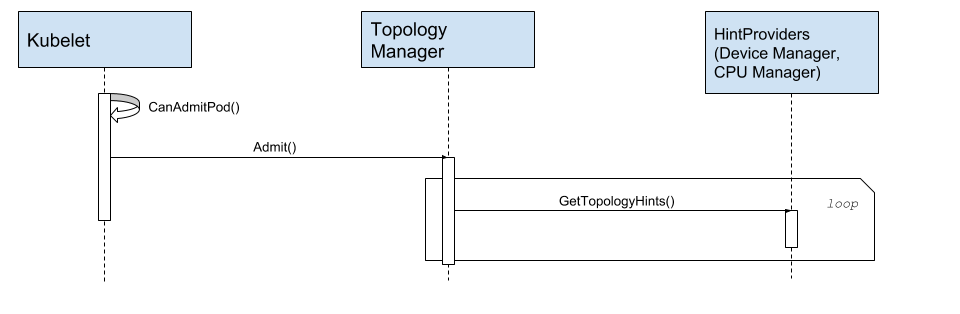 + +_Figure: Topology Manager fetches affinity from hint providers._ + +# Graduation Criteria + +## Phase 1: Alpha (target v1.13) + +* Feature gate is disabled by default. +* Alpha-level documentation. +* Unit test coverage. +* CPU Manager allocation policy takes topology hints into account. +* Device plugin interface includes socket ID. +* Device Manager allocation policy takes topology hints into account. + +## Phase 2: Beta (later versions) + +* Feature gate is enabled by default. +* Alpha-level documentation. +* Node e2e tests. +* Support hugepages alignment. +* User feedback. + +## GA (stable) + +* *TBD* + +# Challenges + +* Testing the Topology Manager in a continuous integration environment + depends on cloud infrastructure to expose multi-node topologies + to guest virtual machines. +* Implementing the `GetHints()` interface may prove challenging. + +# Limitations + +* *TBD* + +# Alternatives + +* [AutoNUMA][numa-challenges]: This kernel feature affects memory + allocation and thread scheduling, but does not address device locality. + +# References + +* *TBD* + +[k8s-issue-49964]: https://github.com/kubernetes/kubernetes/issues/49964 +[nfd-issue-84]: https://github.com/kubernetes-incubator/node-feature-discovery/issues/84 +[sriov-issue-10]: https://github.com/hustcat/sriov-cni/issues/10 +[proposal-affinity]: https://github.com/kubernetes/community/pull/171 +[numa-challenges]: https://queue.acm.org/detail.cfm?id=2852078 |